
Spy Week Four: Mambo
A Spy In The House Of Love Read Along Week #4

Welcome to Week Four of the Spy read-along!
A collaboration with The Anaïs Nin Foundation
This week, we follow Sabina on yet another rendezvous. Let’s dive right in!
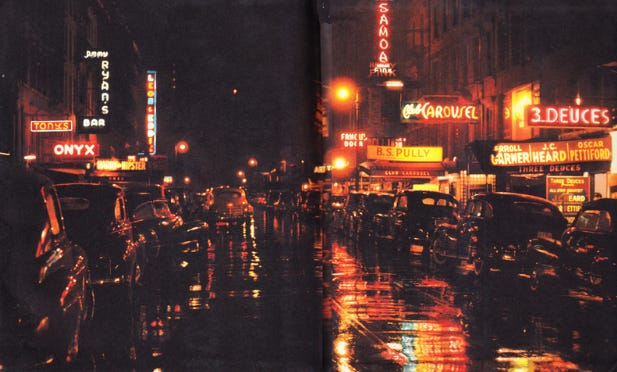
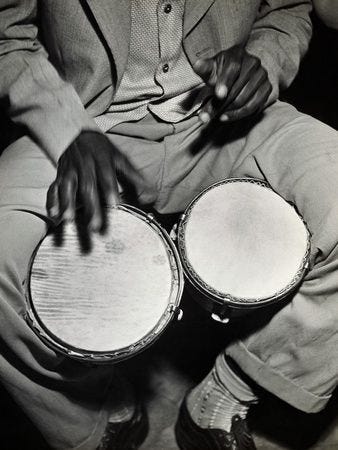
As Sabina walks through the warm evening air, she senses, alongside it, the vibrato of pulsating drums voyaging in rhythmic succession. The pounding of hands upon the drumheads exudes a certain flare of the sensual and hypnotic kind. Sabina, freshly baptized beneath the moonlight, finds herself all too susceptible to these mesmerizing notes of seduction.
Pulled by the reins of this drumming, she discovers a group gathered in a basement off MacDougal Street, and one of the drumming men in particular captures her attention. It is Mambo, and almost immediately she begins projecting a preconceived sensuality onto him, reducing him to a forbidden fantasy before she has even come to know him.
He reciprocates the intensity of her yearning and fantasy, if only slightly, composing a thread between them as he drums, feeding off Sabina’s entrancement. It is here, within the symbiotic nature of the artist and their art form, that she glimpses the life free from convention she so desperately searches for.
“When he stopped drumming he left his hands spread on the drumskin, they continued to look at each other and then away as if fearing everyone had seen the desire flowing between them.”
A Brief History
Anaïs Nin was progressive in many ways, no doubt, from her willingness to discuss female desire and other realms of the taboo. She moved in bohemian circles — in Paris and later Greenwich Village — where Black musicians and artists were her peers and lovers, and she would not have considered herself racist by any measure of her time. In 1968, she “became hysterical” after the assassination of Martin Luther King. She wrote in her diary that she
“Could not bear the cruelty, the horror of it. Knew what a deep wound it would cause the Black people… That it could happen was to me the darkest moment of American history.”
-The Diary of Anaïs Nin, Volume 7, p.57
Yet the language she uses to describe Mambo is undeniably shaped by the racial imagination and undertones of her era. For this reason, reading Mambo's character in 2026 is an uneasy experience. It is impossible to ignore how radical Nin's portrayal of interracial desire would have appeared in 1954. Although New York never enacted a statute banning mixed-race couples, half the states in the Union still had active anti-miscegenation laws on the books. However, it’s impossible to ignore that her reliance on racial exoticization reduces Mambo to a symbol of forbidden desire rather than a fully realized character.
Only in brief moments does she allow him a sense of awareness of the exoticization Sabina is imposing upon him.
When Mambo first speaks to her after they share a sudden but passionate dance he exposes her for this very behavior , aware of what is occurring.
“I know, he said. I know but it cannot be, he said very gently. And then suddenly the anger overflowed: For me it’s everything or nothing. I’ve known this before a woman like you. Desire. It's a desire, but not for me. You don’t know me. It's for my race, it's for the sensual power we have…He reached for her wrist and spoke close to her face: It destroys me. Everywhere desire. And in the ultimate giving, withdrawal. Because I am African. What do you know of me? I sing and drum and you desire me.”
The limited interiority afforded to Mambo's character strikes me as one of the novel's lingering blind spots. Mambo is granted with brief moments of insight, particularly when he recognizes that Sabina is fetishizing him as a racial Other and confronts her with that reality. Yet I find that the novel never fully develops the implications of his awareness. I personally would’ve liked to see Mambo’s character become more developed throughout the chapter. I feel as if Nin’s writing of Mambo reflects a broader tendency among white modernist writers to acknowledge racialized desire without granting racialized characters the same psychological complexity afforded to their white protagonists.
Mambo
Throughout their brief affair, Sabina and Mambo never go anywhere in public together. A stark contrast to the “Vainglorious” pride she experiences upon being seen in public with Phillip in the previous chapters. Sabina's fear of being discovered by Alan is given another undertone: the fear of being seen in public in 1950s America as an interracial couple. This is all too revealing of Nin and her era. While Sabina imagines Mambo as a figure of the free artist, their relationship is, paradoxically, her most constrained. Confined to the nighttime hours of his bedroom, their affair never enters the ordinary rhythms of public life. Mambo remains hidden by the social realities of mid-century America and by Sabina's unwillingness to acknowledge him beyond the realms of fantasy and desire.
We begin to observe through Sabina’s treatment of Mambo the full extent of her neurotic narcissism. She begins by assuming that her desire must always be reciprocated. When Mambo slightly withdraws from their tango of mutual desire she becomes enraged with anxiety:
“He went back to his singing and drumming but no longer offered them to her. Yet she knew he had desired her, and why was he destroying it now? Why? Her anxiety grew so violent she wanted to stop the drumming, stop the others from dancing. “
Or when he confronts her with the reality that she, a white woman who dares only to eroticize him, would never actually marry him, bear his children, or care for his mother. Faced with Mambo's desire for something beyond fleeting passion, Sabina selfishly deflects, insisting that because marriage has never made her feel whole, it cannot possibly fulfill anyone else either:
“Sabina answered him with equal vehemence, throwing her hair away from her face, and lowering the pitch of her voice until it sounded like an insult: “I’ll tell you one thing: if it were only what you say, I’ve had that, and it didn’t hold me, It was not enough, It was magnificent, but it did not hold me. “
But perhaps her most selfish moment comes when she awakes one morning at Mambo's and believes Alan is waiting outside for her. All she can think about is the pain and impending inner destruction of being discovered by Alan. She never once considers the possible ramifications, or even the potential danger, for Mambo if their affair were to be exposed:
“As if she were about to die, she summarized her existence: the heightened moments of passion dissolved as unimportant in the face of the loss of Alan as if this love were the core of her existence.”
Spy
Reading A Spy in the House of Love in 2026, especially the section on Mambo, asks us to reckon with the distance between the 1950s and ourselves. Nin's portrayal of Mambo is rooted in the racial exoticism that ran through much of mid-century modernist writing, and it would be dishonest to ignore it. Others were doing the same: see also Jack Kerouac, Norman Mailer, James Joyce, William Faulkner, and Henry Miller. But context is not the same as an excuse. Understanding the world Nin inhabited, and the particular courage it took to write interracial desire this openly in 1954, doesn't require us to stop thinking critically. It requires us to think even harder about how our reading intersects with authorial intent. Nin’s yearning felt bold in 1954. How does the text's racial exoticization resonate with you as a 2026 reader?
Over to you dear Reader,
Like Phillip, Mambo is a successful artist — but without the material trappings, and representing a forbidden (at least in parts of 1950s America) Other. What is Sabina actually searching for?
Mambo is the least interior of all the men — we get almost no access to his inner life. Is that Nin’s blind spot, or is it deliberate?
Both Mambo and Phillip are artists. What is Sabina looking for in artists specifically?
Her yearning seemed bold in 1954. How does the text’s racial exoticization sit with you as a 2026 reader?
Sabina admits that she and Mambo don’t go anywhere together. Why not? What does that tell us?
What does this chapter reveal about Nin and her era — and how things have changed?
Feel free to respond to these questions directly in the comments, and share any additional thoughts or insights you’d like to contribute to the discussion.
Until next week...
Although I can understand why her chapter with Mambo would be difficult to read in 2026, I also recognize that the novel was written in the 1950s, when racism and exoticism were still deeply embedded in society. After learning more about her life, I believe she was as opposed to racism as she knew how to be within the context of her time.
What I mean is that she may not have known another way to describe someone when those kinds of descriptions had surrounded her for most of her life. She likely understood the obvious injustices of segregation and the cruelty directed toward those considered "other," and that awareness comes through in the novel. At the same time, I think she still felt she had to be somewhat reserved in how she approached those topics because she was writing within the society she lived in. Even though she was willing to explore controversial ideas, she may have had limits she was unconsciously afraid to cross. And I think that's also why Sabina may not have wanted to be seen in public with Mambo.
Beyond that, I want to say how much I love Anaïs Nin's imagery. The way she has Sabina describe desire, what it feels like, how it grows, and how it overtakes her, is beautiful. It's especially powerful whenever Sabina encounters a new man or a new path of desire. Nin captures the intoxicating pull of longing so vividly that it feels almost tangible.
What I find most compelling, though, is that Sabina creates many of these emotional storms for herself, yet she is still consumed by anxiety and fear. She is constantly balancing rebellion with an awareness of what is considered right and wrong. That tension is what makes her feel so human to me. I understand why many readers see Sabina as selfish, and I don't necessarily disagree. But everyone is selfish in some way. We all act according to our own desires, fears, and needs at times. Rather than judging her outright, I find it more interesting to understand why she makes the choices she does. I relate to her need for experiences.
Love this, Marie! 🩷🩷🩷