Spy Week Five: John
A Spy In The House Of Love Read Along Week #5

Welcome back to A Spy In The House Of Love read along. A collaboration with The Anaïs Nin Foundation.
I can’t believe we’re already at week five! Let’s dive in!
Sabina saunters through a sterilized Long Island beach town, deprived of her preferred artistic flair and pace of life. The monotony and uniformity of its neat mansions, coupled with the irony of a sign proclaiming, "This is the site of the most costly church on Long Island," are an affront to her free spirit. She finds the town's inhabitants zombie-like: rather than being consumed by “orgies in the streets, shouts, or poetry,” they are lulled into the placidity of provincial peacetime life.
To exist in a space stripped of magnetism and intensity is, for Sabina, not simply an assault on the spirit but a form of living death.
Until…
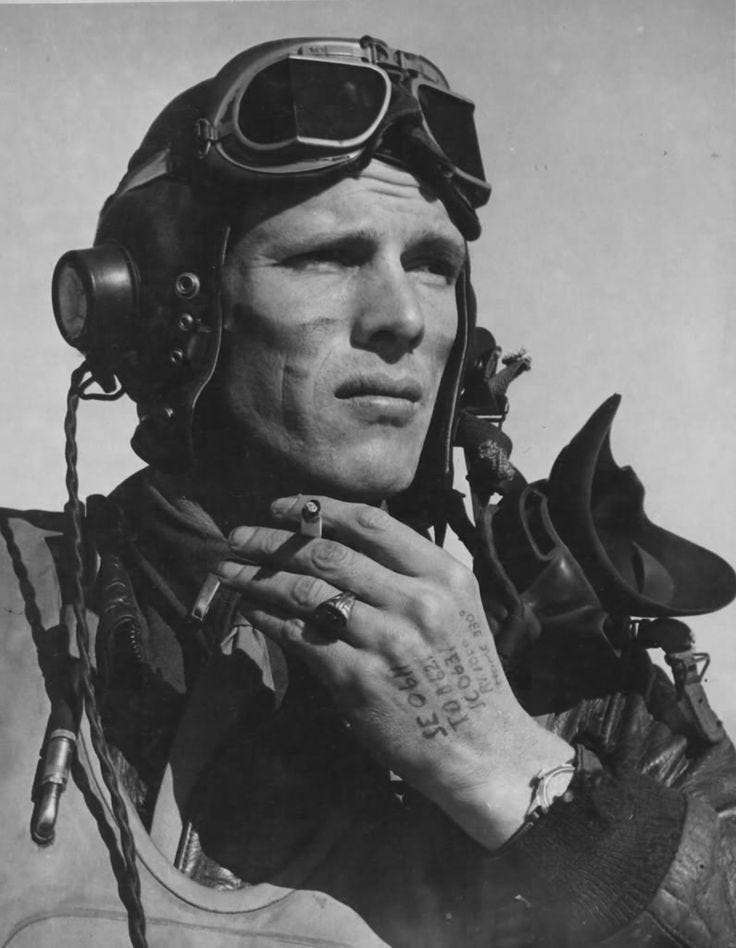
A young man on a bicycle passes by, his silver eyes reflecting back to her the intensity she seeks in such a barren town as this. He is after-all the grounded aviator, restless like her, longing to fling himself back into the expeditious nature of the sky.
John
John, the aviator and war veteran, is a young man of about nineteen and he is arguably the most conventionally attractive man in the novel. Youthful and striking, he possesses passionate eyes whose quality Sabina attributes to having witnessed something other young men have not.
Yet there is something fundamentally unattainable about him, as though some part of him remains elsewhere. Sabina cannot reach him, not in conversation, nor even in the paroxysms of pleasure.
The core of this unattainability lies in the fact that John remains the young boy forever frozen on the battlefield, staring into the eyes of dying men. He recounts to Sabina his experiences in the war, describing how, at seventeen, he first encountered its terrifying extremity and surreality. Though deeply marked by those experiences, he nevertheless longs to return.
“I wish I could be there now, drinking with them, flying, seeing new countries, new faces, sleeping in the desert, feeling you may die any moment and so you must drink fast, and fight hard and laugh hard. I wish I were there now… I'd like to go back. The life here, what people talk about, what they do, think, bores me.”
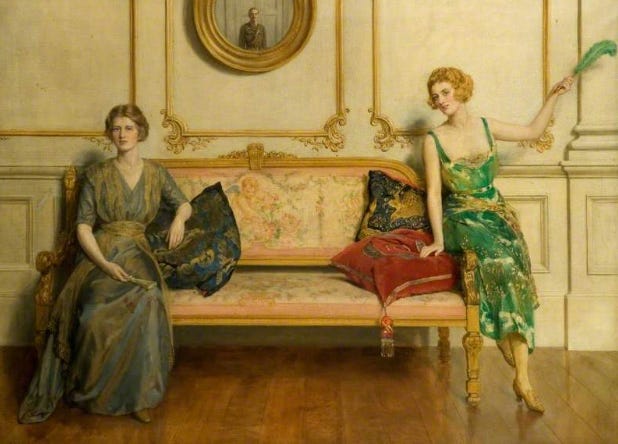
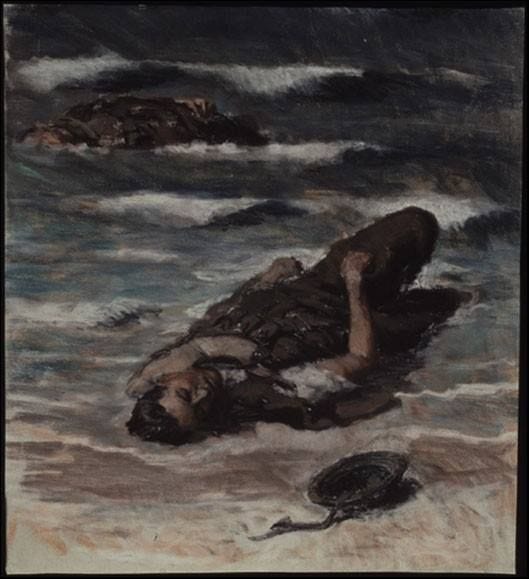
John finds himself incapable of being grounded in peacetime, and unable to relate to the sheltered domesticity and lack of intensity of his peers. Like the soldier in the Collier painting (above), he wants something different from a lover than he did before the war. Today, we might interpret his unrest and dissatisfaction as a symptom of PTSD, but Sabina (and Nin) have no such understanding. Instead, Sabina latches on to his outsider status, the sense that, like her, he is set apart from the world. This is why he and Sabina form an unlikely alliance. They share a mutual ennui and attempt to combat their dissociative states with the stimulation of adventure and absurdity.
However, Sabina eventually realizes that although John is her equal in restlessness, the origins of their unrest could not be more different. Hers is born of boredom and a longing for “orgies, poetry, and shouting in the street,” while his emerges from the profound psychic rupture of experiencing the chaos of war at such a young age.
Sabina initially believes that John's goodness is what poisons her because his sincerity forces her to confront the superficiality of her own pursuit of pleasure.
"She lay back accepting this, but what he tucked in so gently was not a night of pleasure, a body sasiated, but a body in which he had injected the poison which was killing him, the madness of hunger, guilt and death by proxy which tormented him. he had injected into her body his own venomous guilt for living and desiring. he had mingled poison with every drop of pleasure, a drop of poison in every kiss, every thurst of sensual pleasure the thrust of a knife killing what he desired, killing with guilt”
Having witnessed so much death, John cannot experience pleasure without simultaneously feeling that he has betrayed the dead simply by continuing to live and desire. Unable to bear this contradiction, he projects his guilt onto Sabina, casting her as the “bad” woman who can absorb the moral burden he cannot reconcile within himself. When he later sees her walking with Alan, he takes it as confirmation of this projection, finding vindication in his condemnation of her as “bad.”
“Sabina saw that he had succeeded in shifting the shame and that now what he felt was: You’re a bad woman” and that he would never come back to her. Only the poison remained, without hope of the counter-poison.”
Just as Sabina has repeatedly sought in her lovers a remedy for the emptiness within herself, John uses her as a psychological salve for wounds she cannot heal. John does to Sabina what she has so often done to others. Both attempt to cure an inner fracture by remaking another person into the answer. Yet where Sabina is unsettled by the realization that John’s deepest wound lies beyond her reach, John retreats into the certainty of his own projection, leaving them both no closer to the intimacy they sought.
Nin grants us access to Sabina’s inner life, we understand what she takes from this encounter, but John remains opaque, seen only through Sabina’s eyes, and she cannot reach him. She has played her role: the bad woman, the poison, the forbidden thing. But did she feel seen in the playing of it, or does she leave his bed unapplauded? Will John treat the next woman who falls for his silvery eyes the same, or has he learned something? Has Sabina?
Over to you dear Reader….